GovLenseDownload on the App Store

Congress,
in your pocket.

A newspaper-style window into the House and Senate: bills, members, committees, and votes, kept current through the day. No lobbyist budget required.

GovLense pulls from authoritative public sources and normalizes everything into one calm, editorial reading experience. The result is the depth of a staffer’s briefing, written for everybody else.

Free
No fees, no data selling
iOS
App Store
Android
Not yet
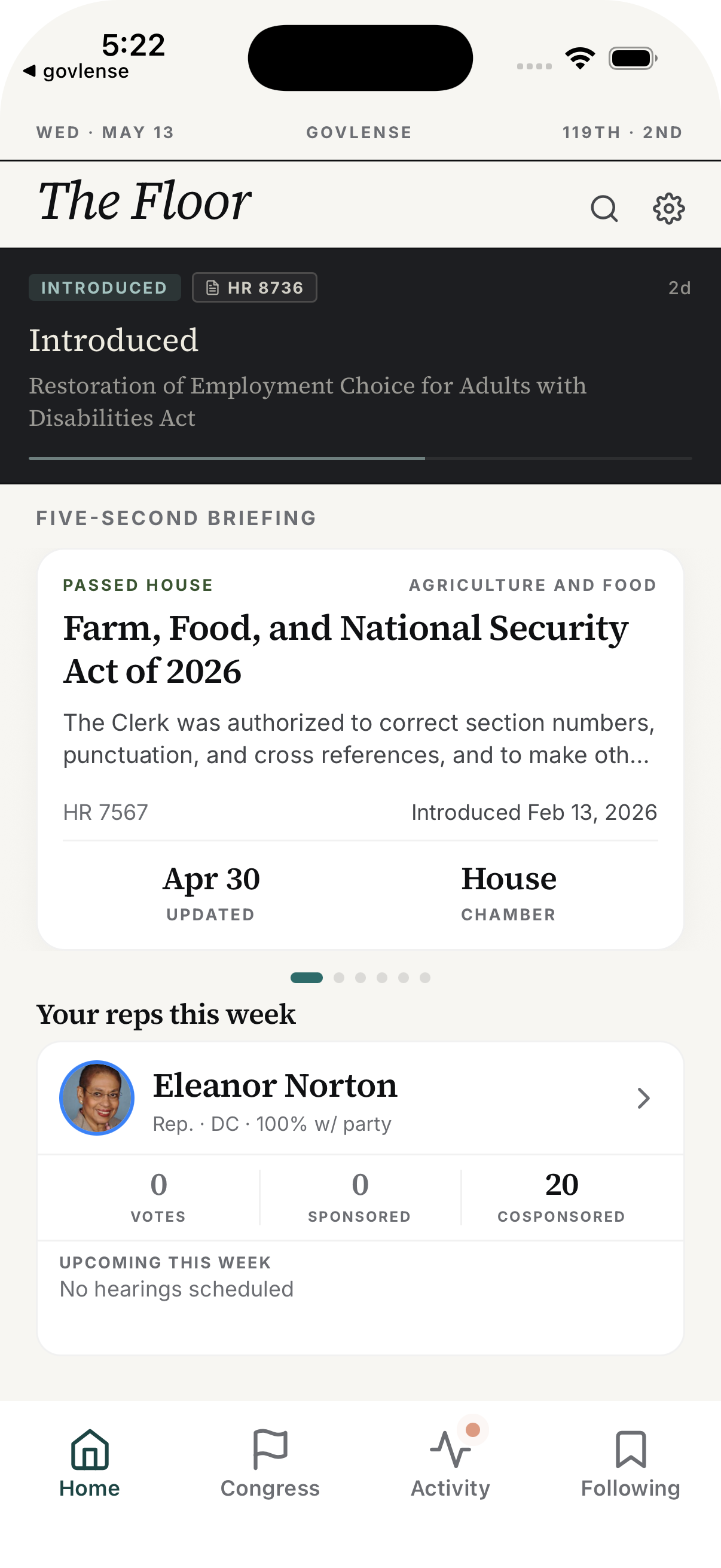
The GovLense Floor screen on an iPhone: a featured-bill deck showing the Farm, Food, and National Security Act of 2026 as passed by the House, and a Your Reps This Week card with a representative's photo and vote counts.
SectionI

The record, on the page.

The Senate, seat by seat.

One hundred seats, two per state. Switch to the House in the app and the room redraws for 435. Colors appear here only because Congress sorts its members this way.

Senate seats by party100 seats: 45 Democratic, 2 Independent, 53 Republican.
Senate composition, 119th Congress
PartySeats
Democratic (D)45
Independent (I)2
Republican (R)53
Seat counts for the 119th Congress. The app shows the current roster. Source: Senate.gov and the @unitedstates legislators dataset.

A bill, stage by stage.

Every bill shows where it stands on the road to law.

Example billPassed House
  1. Introduced (complete)
  2. Committee (complete)
  3. Passed House (current stage)
  4. Passed Senate (not yet)
  5. To President (not yet)
  6. Law (not yet)
Illustration of the app's bill view. Stage names follow Congress.gov.

Your desk, quietly flagged.

Follow what you care about. A small mark appears when something moves.

Illustration of the app's Following list. Bill and member data: Congress.gov.
SectionII

Sourced from the public record.

GovLense is built entirely on the public record. Everything you read in the app comes from Congress.gov and its API, the House and Senate’s own sites, and open-source repositories of government data kept by the civic-tech community. Every bill and amendment links back to its page on Congress.gov.

No leaks. No anonymous sources. No editorializing. We pull from these public sources, normalize the data into one calm reading experience, and surface it without a thumb on the scale.

State legislative data from LegiScan, licensed under CC BY 4.0.

SectionIII

For people who want more than headlines.

The constituent

Track your representative.

See exactly how your House member and both senators voted this week, and how often they vote with their party (the share of roll-call votes where a member sided with most of their own party). Not vibes. The roll call.

A question people askDid my representative show up to vote?
The bill-watcher

Follow what matters to you.

Pin a single bill, or twenty. GovLense quietly marks new activity on each, and can send a note when one passes a chamber, reaches the President, or becomes law. Add a free account for a weekly email recap of everything you follow.

A question people askWhere does the bill I care about stand right now?
The civic-curious

Understand the room.

Composition, age, tenure, attendance, and how far apart the parties vote. The kind of texture you can normally only get if you read political-science papers for fun.

A question people askHow far apart are the two parties, really?

Frequently asked.

Is GovLense free?
Yes. The app is free, including the optional account. We don’t sell data.
Do I need an account?
No. GovLense works fully without one. If you want an account, it’s free and adds a weekly email digest of what you follow. Everything else works the same either way.
Where does the data come from?
Congress.gov and its API, the House and Senate’s own websites, the GPO’s GovInfo, and two open-source civic-data projects: the @unitedstates legislator and roll-call repositories, and Voteview’s DW-NOMINATE scores. We don’t editorialize the data; we just present it. State legislature data comes from LegiScan, licensed under CC BY 4.0, and from Open States.
How fresh is the data?
Votes usually appear within the hour. Bills, amendments and committee activity refresh every four hours, member data twice a day, and ideology scores weekly.
How are featured bills picked?
By a formula, not by an editor. Every four hours GovLense scores bills that had recent action: how far along they are, whether they had a recent roll-call vote, how many members recently signed on, and how much happened lately. Ceremonial measures, such as naming a post office or recognizing an awareness day, are left out, and an automated tier for how significant a bill seems nudges the order a little. The formula does not look at party.
Is GovLense affiliated with any party?
No. We use blue and red because Congress does. Our job is to surface the public record clearly, not to take sides on what’s in it.
Where are my follows stored?
On your device. They only leave it if you turn on notifications or create a free account. We can’t alert you about a bill, or write your digest, without knowing which bills you follow. Both are opt-in and reversible at any time. We don’t currently sync follows between devices.
Available now

The whole record.
In one calm app.

Now on iPhone. Free and quiet. Read the room, then read the bill.

Download on the App Store